myCCC

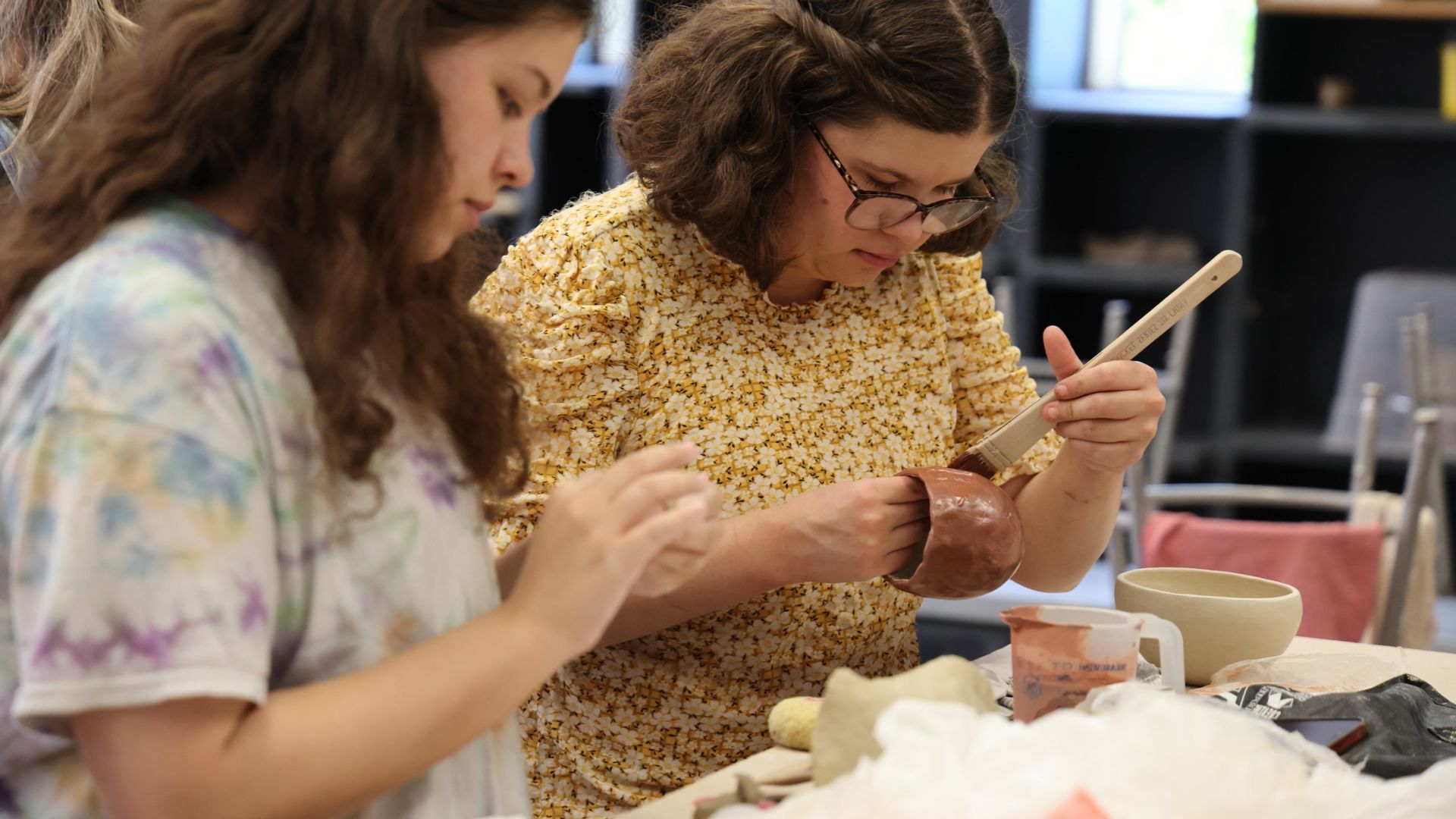

How does a lump of clay become a bowl? Why does one photograph hold your attention? What can a painting tell you about the people who made it? Art offers ways to express your ideas and understand someone else’s.
At CCC, you can study fine art, digital art, photography, and art history. Try a new material, build your creative skills, or learn more about the images and objects around you.
You can start taking the general education classes you need for a bachelor’s degree at CCC. The Arizona General Education Curriculum (AGEC) includes approved classes in writing, math, science, humanities, and social and behavioral sciences. Completing the full AGEC at CCC meets the general education requirements usually taken during the first two years at Arizona State University (ASU), Northern Arizona University (NAU), and the University of Arizona (U of A).
Approved art history and appreciation courses can help you meet the arts and humanities requirement, which focuses on human expression, ideas, and culture. Some art courses may count toward your future major, degree electives, or other requirements, depending on the class and university. These courses do not automatically meet an AGEC general education requirement. Not every class will count toward every degree. Before registering, meet with an academic advisor to choose classes that fit the university and bachelor’s degree you want. Planning early can help you avoid taking classes you do not need.
There’s more than one way to make your mark. How can shading make a drawing look three-dimensional? How does the shape of a ceramic piece affect its appearance and use? Fine art focuses on making artwork. Through drawing, painting, and ceramics, you can practice turning an idea into something others can see or hold.
If you enjoy making things or want to try a new material, start with questions like these:
Drawing: How can color, composition, lines, and texture represent what you see?
Painting: How do colors and painting techniques affect the mood of a piece?
Ceramics: How can you shape clay into objects that are useful, expressive, or both?
Color and design: How do balance, contrast, and the arrangement of shapes guide someone’s attention?
Financial Aid Eligible
In-Person Classes
Online Classes
Hybrid learning required
Evening Classes Available
Transferrable
Military Education Benefits Eligible
Limited start dates
Skills You Can Build
Students develop skills that can help them:
Making art gives you room to experiment and learn from the results. A drawing may need a different composition, or a clay form may require a new approach. Working through these decisions helps you become more observant, patient, and willing to try another solution.
Observe closely: Notice details in shape, texture, color, and space.
Solve problems: Adjust your approach when a material or design does not work as expected.
Communicate visually: Use materials and design choices to express an idea.
Evaluate your work: Identify what works in a piece and what you could improve.
Fine art courses can introduce you to further study in drawing, painting, ceramics, or other fine arts. They can also build skills useful in design and art education. If you plan to pursue a bachelor’s degree in fine arts, explore CCC’s Associate of Fine Arts in Visual Arts. An academic advisor can help you choose courses that fit your degree requirements and transfer plans.
Your screen can be a place to make art. How can you combine images to communicate an idea? What changes when you adjust a color or remove part of a picture? Digital art uses computer tools to create and edit visual work. CCC’s offerings include computer graphics and Adobe Photoshop.
If you’re interested in creating with a computer, consider questions like these:
Computer graphics: How can digital tools help you build a visual design?
Image editing: How do changes to color, size, or composition affect an image?
Visual communication: How can you arrange images and other elements to make a message clear?
Creative choices: How do you decide which tools and changes serve your idea?
Financial Aid Eligible
In-Person Classes
Online Classes
Hybrid learning required
Evening Classes Available
Transferrable
Military Education Benefits Eligible
Limited start dates
Skills You Can Build
Students develop skills that can help them:
Digital tools give you ways to test an idea, compare versions, and revise your work. Learning to use them thoughtfully can help you move beyond choosing an effect simply because it looks interesting. You can consider what each change adds and how it helps communicate your message.
Use digital tools: Build confidence working with graphics and image-editing software.
Organize visual information: Arrange elements so viewers know where to look.
Compare solutions: Try different versions and explain which one works best.
Revise with purpose: Make changes that improve clarity or support your idea.
Digital art courses can introduce you to further study in digital art or graphic design and build skills useful in marketing, communication, and media. An academic advisor can help you choose courses that fit your degree requirements and transfer plans.
Every artwork has a context. Why did an artist choose a particular subject? What can a building, painting, or sculpture reveal about a community? Art history and appreciation examine works of art alongside the ideas, events, and cultures that help explain them.
If you’re curious about the stories behind artwork, start with questions like these:
Art and culture: How does artwork reflect the beliefs and experiences of the people who made it?
Styles and change: How have approaches to making art changed over time?
Visual details: What can materials, colors, shapes, and symbols tell us about a work?
Interpretation: Why might people understand the same artwork differently?
Financial Aid Eligible
In-Person Classes
Online Classes
Hybrid learning required
Evening Classes Available
Transferrable
Military Education Benefits Eligible
Limited start dates
Skills You Can Build
Students develop skills that can help them:
Looking carefully at artwork can reveal more than a first impression. Learning about its context helps you understand choices that may seem unfamiliar and consider experiences different from your own. You also get practice explaining your interpretation and supporting it with evidence.
Interpret evidence: Use visual details and historical information to support an explanation.
Compare perspectives: Consider how people’s experiences influence their responses to art.
Make connections: Relate artwork to broader cultural and historical ideas.
Explain clearly: Describe what you see and why you think it matters.
Art history and appreciation courses can introduce you to further study in art history or fine arts and support interests in museum work, education, and cultural studies. An academic advisor can help you choose courses that fit your degree requirements and transfer plans.
A different angle can change the whole picture. Why does the same place look different in two photographs? How does light change the mood of an image? Photography combines technical skills with decisions about what to show and how to show it.
If you enjoy taking pictures and want to understand what makes an image work, consider questions like these:
Composition: How does placing a subject in different parts of the frame change a photograph?
Light and shadow: How does lighting affect the details and mood of an image?
Point of view: What changes when you move closer, step back, or photograph from another angle?
Visual meaning: How does what you include or leave out affect what a photograph communicates?
Financial Aid Eligible
In-Person Classes
Online Classes
Hybrid learning required
Evening Classes Available
Transferrable
Military Education Benefits Eligible
Limited start dates
Skills You Can Build
Students develop skills that can help them:
Photography helps you notice things you might otherwise pass by, from changing light to patterns in a familiar place. It also encourages you to think about how images shape your understanding of people and events. These habits can help you take more thoughtful photographs and look more critically at images in news, advertising, and social media.
Pay attention to detail: Notice how small changes affect the image as a whole.
Make thoughtful decisions: Choose what to include based on what you want to communicate.
Evaluate visual messages: Consider how framing and viewpoint influence a viewer’s understanding.
Adjust your approach: Compare results and try another solution when an image does not communicate what you intended.
Photography courses can introduce you to further study in photography or fine arts and build visual communication skills useful in journalism, marketing, and media. CCC’s Associate of Fine Arts also supports students planning to continue their fine arts education in photography. An academic advisor can help you choose courses that fit your degree requirements and transfer plans.
A bowl starts with a lump of clay. What keeps the walls from collapsing as you shape them? How does a glaze change in the kiln? Ceramics gives you a chance to work through those questions as you turn soft clay into a finished piece.
If you like working with your hands or want to try a new art material, start with questions like these:
Handbuilding: How can you pinch, coil, or join pieces of clay to build a form?
Wheel throwing: How do you center clay on a spinning wheel and shape it into a bowl or cup?
Surface design: How can you use texture, patterns, or glaze to change how a piece looks and feels?
Firing: What happens when clay and glaze are heated in a kiln?
Financial Aid Eligible
In-Person Classes
Online Classes
Hybrid learning required
Evening Classes Available
Transferrable
Military Education Benefits Eligible
Limited start dates
Skills You Can Build
Students develop skills that can help them:
Clay gives you quick feedback. A rim might wobble as you shape it, or a handle might feel awkward once you hold the cup. Working through those details helps you see how small choices affect how a piece looks and how someone uses it.
Plan ahead: Think through the order of your steps and what you’ll need at each stage.
Notice small changes: Pay attention to details like thickness, balance, and moisture.
Adjust your approach: Change your technique when a material responds differently than you expected.
Learn from the result: Compare the finished piece with your original idea and decide what to try next.
Ceramics courses can introduce you to further study in ceramics or fine arts and build skills in working with materials and designing three-dimensional objects. These skills are useful in studio art, product design, and art education. CCC’s Associate of Fine Arts also supports students planning to continue their fine arts education in ceramics. An academic advisor can help you choose courses that fit your degree requirements and transfer plans.
No. Many students begin with general education courses before deciding on a specific area of focus. If you have a general interest in art and art history, an advisor can help you choose courses that count toward your AGEC and align with your likely transfer major at the same time.
Yes, when completed as part of the AGEC. The Arizona General Education Curriculum is a statewide agreement that guarantees your general education credits transfer as a block to ASU, NAU, and U of A. If you complete the AGEC with a 2.5 GPA, you are also guaranteed unconditional admission to any of those universities.
Art history and appreciation courses can count toward the art and humanities category of the Arizona General Education Curriculum. Some courses may meet other AGEC requirements or count as electives. Your advisor can help you choose courses that apply to your degree and transfer plans.
Sometimes, but requirements depend on the class. Before purchasing anything, check your class supply list or ask your instructor about required art supplies, camera equipment, or software access. Check tuition and course fees as well so you can plan for the full cost.
No. These subjects can complement many majors or give you a chance to try something new. Check course prerequisites before registering and talk with an advisor about how a class fits your academic plan.
If you do want to major in an art field, CCC’s Associate of Fine Arts in Visual Arts is designed to transfer to fine arts bachelor’s programs at Arizona’s public universities. It prepares students for further study in areas including drawing, painting, photography, ceramics, and sculpture. Meet with an advisor early because university requirements differ.
Yes. All CCC classes are open to everyone as long as you have completed any prerequisites. However, taking a class outside of your degree will not be covered by financial aid, including money from the Pell grant, federal student loans, and military education benefits. You need plan to cover the expenses for any classes outside of your degree out-of-pocket.
That depends on what you want to study and where you plan to transfer. CCC has university guides for art and art history that outline recommended course order for students planning to transfer to NAU, ASU, and U of A. Your advisor can walk you through those guides and help you build a plan that gets you to your goal without taking courses you do not need.
Art, photography, ceramics, and art history courses can introduce you to further study in the visual arts. They also build skills useful in design, photography, marketing, media, education, and museum work. Career requirements vary; some roles require further education, a portfolio, or professional credentials.
We are here to help. Complete the form to get in contact with admissions, campus tours, and more.
Our admissions team is ready to get you started. Fill out our free, 10-minute application to build the future you want.
Complete the form to get in contact with admissions, campus tours, and more.