myCCC

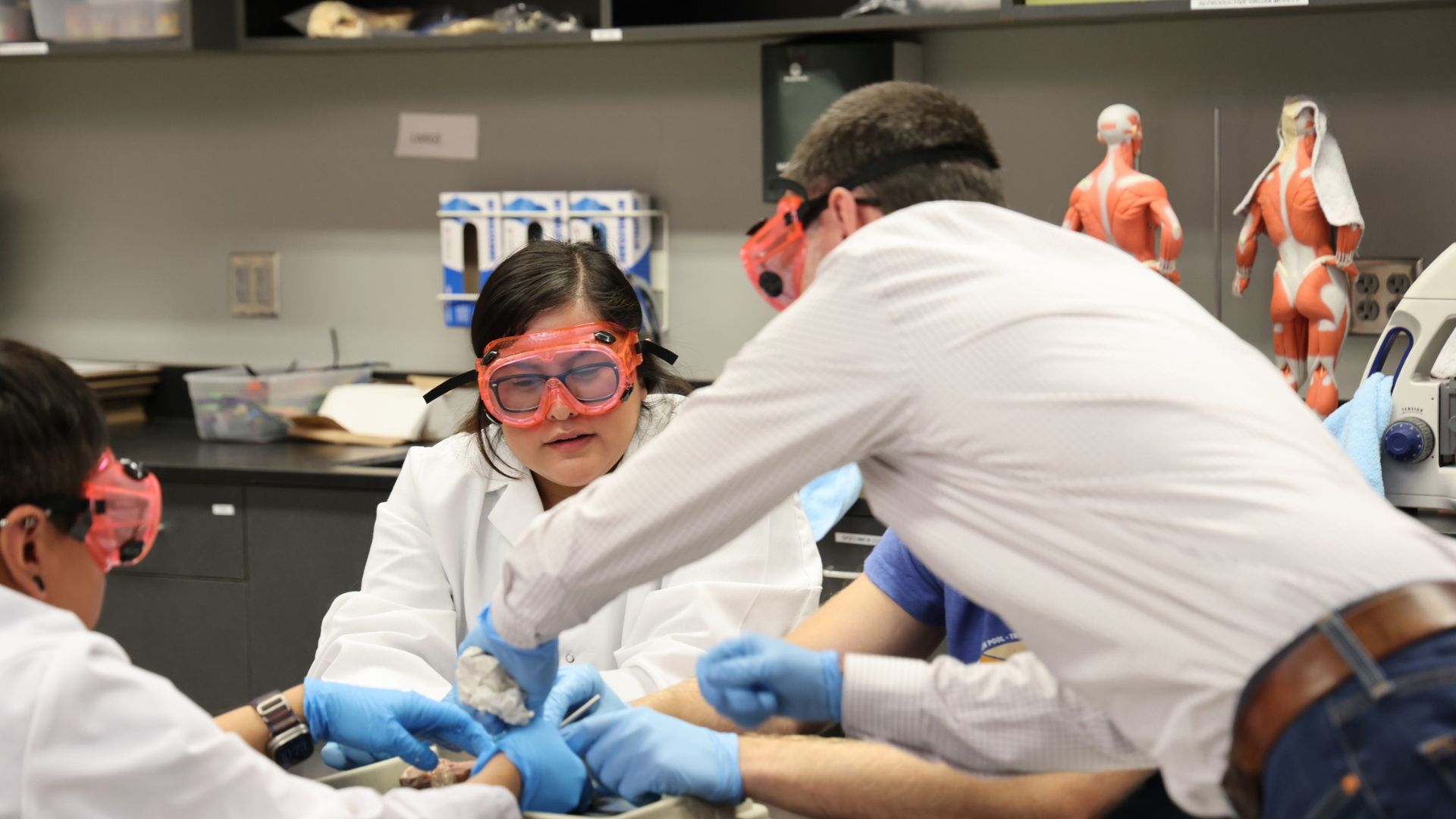

How do cells keep your body working? What happens when an ecosystem changes? How did northern Arizona’s layers of rock get here? Biology, environmental science, and geology offer different ways to understand the natural world.
At CCC, you can study living things, examine relationships between people and the environment, or investigate Earth’s history and processes. Follow your curiosity while learning to ask questions, interpret evidence, and explain what you find.
You can start taking the general education classes you need for a bachelor’s degree at CCC. The Arizona General Education Curriculum (AGEC) includes approved classes in writing, math, science, humanities, and social and behavioral sciences. Completing the full AGEC at CCC meets the general education requirements usually taken during the first two years at Arizona State University (ASU), Northern Arizona University (NAU), and the University of Arizona (U of A).
Approved biology, environmental science, and geology courses can help you meet the Natural Sciences general education requirement. These classes focus on understanding living things, the environment, and Earth through observation, scientific investigation, and examining evidence. Not every class will count toward every degree. Before registering, meet with an academic advisor to choose classes that fit the university and bachelor’s degree you want. Planning early can help you avoid taking classes you do not need.
Get to know the life around and within you. How does a single cell carry out the work of living? How do your body’s systems work together? Biology studies living things, from microscopic organisms to complex plants and animals. CCC’s courses include biology concepts, cell biology, anatomy and physiology, microbiology, and environmental biology.
If you’re curious about living things or how your body works, start with questions like these:
Cells: How do cells carry out the processes that keep organisms alive?
Living organisms: How do plants, animals, and other organisms grow and function?
The human body: How do body structures and systems work together?
Microorganisms: What can organisms too small to see with the naked eye tell us about life?
Organisms and their environments: How do living things interact with their surroundings?
Financial Aid Eligible
In-Person Classes
Online Classes
Hybrid learning required
Evening Classes Available
Transferrable
Military Education Benefits Eligible
Limited start dates
Skills You Can Build
Students develop skills that can help them:
Biology connects to questions you encounter in everyday life, from how your body functions to why changes in an environment affect the organisms living there. Studying it can help you understand scientific explanations and look more carefully at claims about health and the natural world.
Observe carefully: Notice details and differences in organisms, structures, and processes.
Interpret evidence: Use observations and data to support an explanation.
Understand connections: Examine how a change in one part of a living system affects another.
Explain clearly: Describe a scientific process in a way someone else can understand.
Biology courses can introduce you to further study in biology, biomedical sciences, microbiology, or related fields. They can also support preparation for health care and environmental studies. An academic advisor can help you choose courses that fit your degree requirements and transfer plans.
Some transfer degrees related to this subject require specific or higher-level math courses. You may also need to complete math placement before registering. Your academic advisor can help you understand these requirements and choose the right math course for your transfer plans.
What happens in one place can affect another. How does a change in water quality affect living things? How do people depend on and change the environments around them? Environmental science examines these connections using ideas from biology and the physical sciences. Even everyday choices about water, energy, and land can have effects that reach beyond your own community.
If you’re interested in the environment and how people interact with it, consider questions like these:
Ecosystems: How do living things interact with each other and their surroundings?
Human impacts: How can human activities change natural environments?
Natural resources: How do people depend on water, land, and other resources?
Environmental change: What evidence helps us understand changes in an ecosystem?
Financial Aid Eligible
In-Person Classes
Online Classes
Hybrid learning required
Evening Classes Available
Transferrable
Military Education Benefits Eligible
Limited start dates
Skills You Can Build
Students develop skills that can help them:
Decisions about water, land, and resources affect communities and the living things around them. Environmental science helps you understand the connections behind those decisions. You can use that knowledge to ask informed questions, examine environmental claims, and consider the effects of different choices.
Think about connections: Trace how a change in one part of an environment can affect another.
Evaluate information: Look for evidence behind claims about environmental issues.
Consider consequences: Examine how decisions may affect people and ecosystems.
Explain complex issues: Describe environmental relationships in clear, practical terms.
Environmental science courses can introduce you to further study in environmental science, ecology, conservation, or natural resource management. They can also add a scientific perspective to interests in public policy and community planning. An academic advisor can help you choose courses that fit your degree requirements and transfer plans.
Some transfer degrees related to this subject require specific or higher-level math courses. You may also need to complete math placement before registering. Your academic advisor can help you understand these requirements and choose the right math course for your transfer plans.
The landscape has a story to tell. Why do rock layers look different from one another? What causes a volcano to erupt? Geology studies Earth’s materials, history, and the processes that shape its surface and interior. Look closer at the Colorado Plateau and beyond to understand how landscapes form and continue to change.
Rocks and minerals: What can Earth’s materials tell us about how and where they formed?
Earth’s history: How do rock layers preserve evidence of earlier environments and events?
Natural hazards: What processes cause events such as earthquakes and volcanic eruptions?
The Colorado Plateau: What shaped the landscapes of this region?
Planetary science: What can other worlds tell us about the processes that shape planets?
Financial Aid Eligible
In-Person Classes
Online Classes
Hybrid learning required
Evening Classes Available
Transferrable
Military Education Benefits Eligible
Limited start dates
Skills You Can Build
Students develop skills that can help them:
Geology can change how you see a familiar landscape. A cliff, a rock layer, or a volcanic feature becomes evidence you can examine and explain. It also provides context for everyday concerns such as natural hazards, land use, and the resources people depend on.
Recognize patterns: Compare materials and features to identify similarities and differences.
Interpret evidence: Use observations to explain events you could not witness directly.
Think in three dimensions: Consider how structures fit together above and below the surface.
Connect causes and effects: Explain how processes can change a landscape over time.
Geology courses can introduce you to further study in geology, earth science, or planetary science. They can also support interests in environmental work, natural resources, and land management. An academic advisor can help you choose courses that fit your degree requirements and transfer plans.
Some transfer degrees related to this subject require specific or higher-level math courses. You may also need to complete math placement before registering. Your academic advisor can help you understand these requirements and choose the right math course for your transfer plans.
Start with the questions that interest you. Biology focuses on living things and how they function. Environmental science examines relationships between people and the natural environment. Geology focuses on Earth’s materials, history, and processes. Some programs have specific science prerequisites. If you are planning to transfer, your intended major may also influence which courses you take first. An academic advisor can help you identify the best path for your goals.
No. Approved courses can help students in many majors meet the Natural Sciences general education requirement. Check prerequisites before registering, and choose a course that fits your degree and experience.
Requirements vary by course. Check the current course description for any required math, English, or earlier science classes. If you plan to major in a science field, meet with an advisor early to discuss math placement and the order in which to take your courses. Some programs require more advanced math.
That depends on the health program you want to enter. CCC’s biology offerings include Human Anatomy and Physiology I and II and Microbiology, but programs have specific course and admission requirements. Meet with an advisor before choosing a class.
The approved courses in these subjects can help fulfill the AGEC Natural Sciences requirement. Your intended major may also require specific science courses. A class that meets a general education requirement may not meet a major requirement, so plan your choices with an advisor.
Check the course description for lecture and lab hours. A lab gives you time to practice scientific skills through activities such as experiments, observations, and working with data. Before registering, ask an advisor which science courses and labs your degree requires. Check the class schedule for any separate lab meeting times.
Yes. All CCC classes are open to everyone as long as you have completed any prerequisites. However, taking a class outside of your degree will not be covered by financial aid, including money from the Pell grant, federal student loans, and military education benefits. You need plan to cover the expenses for any classes outside of your degree out-of-pocket.
We are here to help. Complete the form to get in contact with admissions, campus tours, and more.
Our admissions team is ready to get you started. Fill out our free, 10-minute application to build the future you want.
Complete the form to get in contact with admissions, campus tours, and more.