myCCC

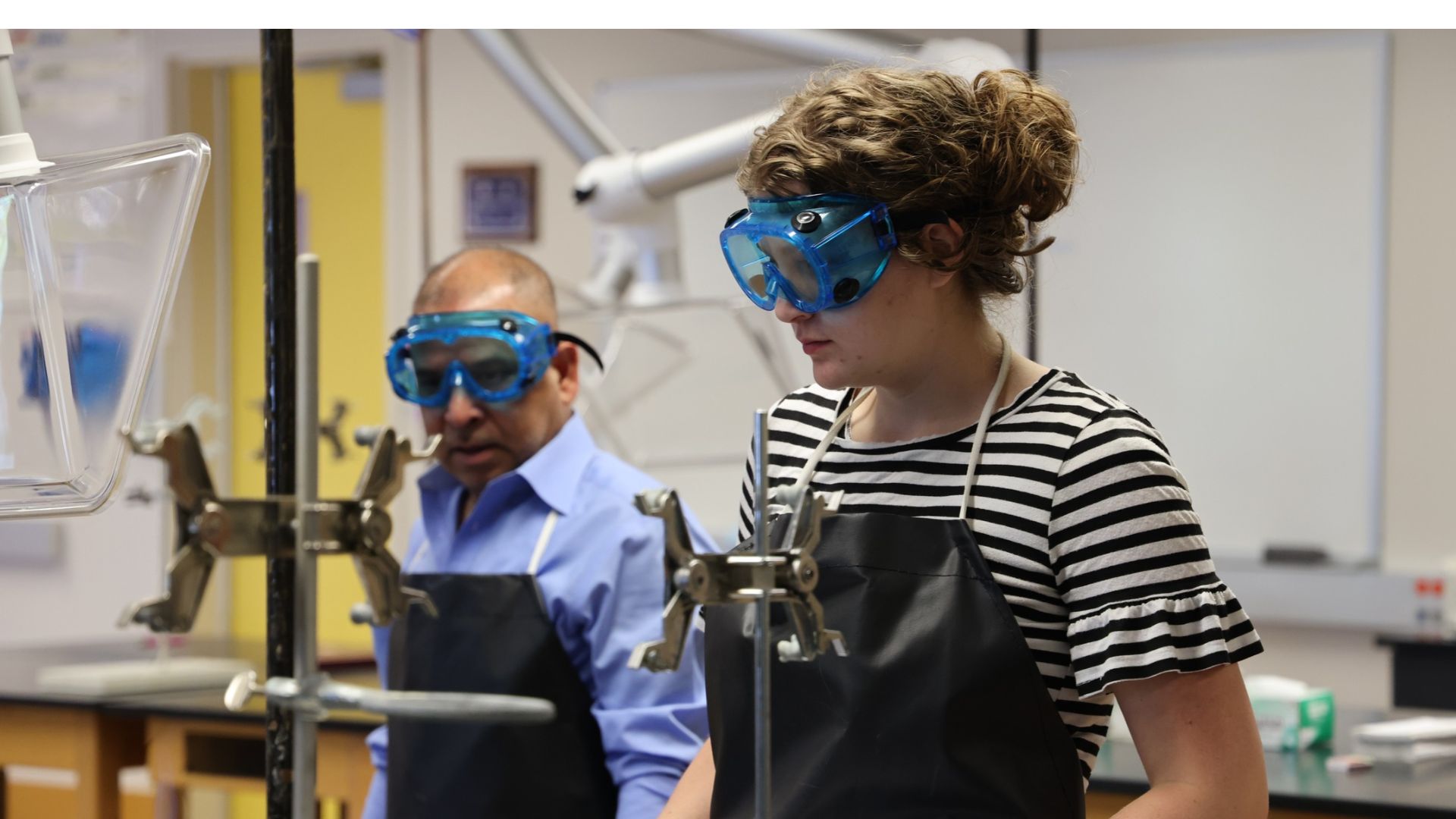

Why does metal rust? How does a seat belt protect you when a car stops? What keeps a planet in orbit? Chemistry and physics help explain the materials, forces, and energy involved in everyday life.
Chemistry examines matter and how it changes. Physics studies motion, energy, and the interactions that shape the physical world. Build your understanding while practicing how to ask questions, work through problems, and test explanations.
You can start taking the general education classes you need for a bachelor’s degree at CCC. The Arizona General Education Curriculum (AGEC) includes approved classes in writing, math, science, humanities, and social and behavioral sciences. Completing the full AGEC at CCC meets the general education requirements usually taken during the first two years at Arizona State University (ASU), Northern Arizona University (NAU), and the University of Arizona (U of A).
Approved chemistry and physics courses can help you meet the Natural Sciences general education requirement. These classes focus on understanding matter, energy, and the physical world through observation, experiments, and mathematical reasoning. Not every class will count toward every degree. Before registering, meet with an academic advisor to choose classes that fit the university and bachelor’s degree you want. Planning early can help you avoid taking classes you do not need.
Small changes can make a big difference. Why do some substances dissolve in water while others don’t? What happens when materials react with each other? Chemistry studies the substances that make up our world and how they interact and change. Connect what happens at the level of atoms and molecules with changes you can observe.
If you’re curious about materials or why substances behave differently, start with questions like these:
Atoms and molecules: How do the building blocks of matter combine to form different substances?
Chemical reactions: What happens when substances change into something new?
Properties of matter: Why do materials have different physical and chemical properties?
Energy and change: How do chemical processes absorb or release energy?
Measurement: How can quantities and observations help explain what happens in a reaction?
Financial Aid Eligible
In-Person Classes
Online Classes
Hybrid learning required
Evening Classes Available
Transferrable
Military Education Benefits Eligible
Limited start dates
Skills You Can Build
Students develop skills that can help them:
Chemistry is the study of matter which has an application for anything and everything, from cooking and cleaning to health, manufacturing, and the environment. Studying it gives you practice connecting an explanation you cannot see directly with evidence you can measure and observe.
Measure carefully: Pay attention to quantities, units, and the accuracy of your results.
Follow a process: Work through steps in a logical order and keep clear records.
Evaluate evidence: Compare observations with an explanation or prediction.
Solve problems: Use scientific ideas and calculations to work out an answer.
Chemistry courses can introduce you to further study in chemistry, biochemistry, or related sciences. They can also support preparation for health care, engineering, and environmental studies. An academic advisor can help you choose courses that fit your degree requirements and transfer plans.
Some transfer degrees related to this subject require specific or higher-level math courses. You may also need to complete math placement before registering. Your academic advisor can help you understand these requirements and choose the right math course for your transfer plans.
There’s a reason things move the way they do. Why is it harder to stop a moving truck than a bicycle? How does energy travel from one place to another? Physics studies motion, forces, matter, and energy. Use observations and mathematical models to make sense of events ranging from everyday movement to the motion of objects in space.
If you enjoy figuring out how things work, consider questions like these:
Motion and forces: What makes an object speed up, slow down, or change direction?
Energy: How is energy transferred or changed from one form to another?
Electricity and magnetism: How do electric charges and magnetic fields interact?
Waves and light: How do waves carry energy, and how does light behave?
Astronomy: How can physical principles help explain objects and events in the universe?
Financial Aid Eligible
In-Person Classes
Online Classes
Hybrid learning required
Evening Classes Available
Transferrable
Military Education Benefits Eligible
Limited start dates
Skills You Can Build
Students develop skills that can help them:
Physics helps you break a complicated problem into parts you can examine. You identify what matters, choose a useful model, and check whether your answer makes sense. That approach can help you understand technology and solve problems that extend beyond a science classroom.
Break down problems: Identify the information you have and what you need to find.
Use mathematical models: Connect equations and graphs with physical situations.
Test predictions: Compare what you expect with what you observe or measure.
Check your reasoning: Consider whether an answer is reasonable and what assumptions it depends on.
Physics courses can introduce you to further study in physics, astronomy, or engineering. They can also strengthen mathematical reasoning useful in technology and other science fields. An academic advisor can help you choose courses that fit your degree requirements and transfer plans.
Some transfer degrees related to this subject require specific or higher-level math courses. You may also need to complete math placement before registering. Your academic advisor can help you understand these requirements and choose the right math course for your transfer plans.
Chemistry focuses on substances, their properties, and how they change. Physics focuses on motion, forces, energy, and the principles that explain physical interactions. Both can help you meet general education requirements, but your intended major may require a specific course or sequence.
No. Approved chemistry and physics courses can help students in many majors meet the Natural Sciences general education requirement. Check the prerequisites and talk with an advisor about which course fits your interests, preparation, and degree plan.
The math requirements depend on the course. You may use equations, graphs, measurements, and unit conversions to solve problems. If you plan to study science or engineering at a university, meet with an advisor early to plan your math and science sequence. Some programs may require more advanced math.
Check the course description for lecture and lab hours. Labs give you opportunities to investigate scientific ideas through activities such as experiments, measurements, and data analysis. Review the class schedule for required meeting times, and ask an advisor which science courses and labs your degree requires.
Not necessarily. A course may fulfill an AGEC requirement without meeting a specific major requirement. CCC’s approved list includes both College Physics and University Physics courses, so check the exact sequence your intended university and major require. Planning with an advisor can help you avoid taking a course that does not move you toward your goal.
Yes. All CCC classes are open to everyone as long as you have completed any prerequisites. However, taking a class outside of your degree will not be covered by financial aid, including money from the Pell grant, federal student loans, and military education benefits. You need plan to cover the expenses for any classes outside of your degree out-of-pocket.
We are here to help. Complete the form to get in contact with admissions, campus tours, and more.
Our admissions team is ready to get you started. Fill out our free, 10-minute application to build the future you want.
Complete the form to get in contact with admissions, campus tours, and more.